Isolated. Kind of a funny word when you really look at it. I can’t articulate exactly why I feel that way, but stare at it long enough and you might get what I mean. The word doesn’t always carry a positive connotation. In fact, I think it could be argued that most folks would put isolation in the “cons” side of the chart when evaluating a thing. However, for those folks like me who carry the affliction of needing to spend time in places where very few others spend time, and needing to give a damn about things that very few others give a damn about – isolation is that which we seek. A place where we find our state of flow and the ordinary becomes exceptional. A deviation from the standard order of things. Maybe it’s the exceptional nature of fly fishing that drew me back to the long rod after a 15 year hiatus. After all, I’ve always been one to favor total immersion over dipping a toe in and while there’s a thousand different ways to go about catching a fish on a fly rod, none of them involve half-assing it.
I got back into fly fishing with trout on the brain. Clear mountain streams, banks covered with bright and fragrant wildflower blooms, beautiful little fish so fragile you can barely lay a hand on them for fear of disrupting the delicate balance that defines their existence…just like hollywood showed you in A River Runs Through It. The visions in my head of long days exploring remote stream basins to find undisturbed populations of native fish were short-lived. Quickly replacing them were the hard truths that I am a 36-year old man with an amazing wife, two happy and healthy young daughters and way less free time than he used to have. I’d like to take a moment to make it clear that I posses infinite gratitude for the women in my life and know that without them I’d be a shell of myself, but the responsibilities of being a husband and father can really put a dent in unencumbered time on the water – and today I’m writing about fishing.
Enter: the humble bass.
When I say “bass”, the picture you have in your head is likely that of a largemouth bass. The fish that Bill Dance used to proudly display for the camera in his signature high-crown “power t” hat. Green back fading to a white belly, black stripe down the side and a gaping maw that has evolved to snatch up anything that can fit. Literally. Bass are known as “gape-limited predators” which effectively means that if it can fit in their mouth and the mood strikes, they’ll try to eat it. There are 9 species of black bass that are native to the continental US, and here in North Carolina, we have 3 that I know of. The largemouth bass, the spotted bass and the smallmouth bass. Micropterus Dolomieu, the smallmouth bass, is not a native NC fish. They’re actually native to the Mississippi River basin and made their way here through various NCWRC stocking programs over the last half-century or so, give or take a decade. They’ve done quite well in certain areas of the state, but the general consensus amongst freshwater anglers in North Carolina has mostly been: if you want to catch a smallmouth bass here, you need to be north of I-40 and/or west of I-77.
Spoiler alert: you don’t.
The Uwharrie Mountains have long been a stronghold of isolation, almost as if they inspired the definition of the word. In just my lifetime, the population of North Carolina has more than tripled, and I’ve seen that growth benefit the state and her citizens in a myriad of ways. However, for myself and countless others it has also served to highlight the importance of places like the Uwharries and the work that it takes to keep them wild. As you drive into the low mountain range, you leave behind the high-rise apartments, 8-lane highways and endless shopping center developments that define NC’s metro areas. The scene around you transitions, almost out of nowhere, into one of dirt roads, small towns and limited cellular service. The Uwharrie River cuts right through the middle of it all on a 62-mile southerly course after rising at the edge of High Point’s city limits. The river is not a place where smallies are supposed to be, not unlike the mountains that surround it. In true Uwharries fashion, the origin story of these fish in this place is a bit of a legend.
Legend has it that the NCWRC stocked 2 tributary creeks of the Uwharrie in the early 70’s. No, I won’t tell you which creeks. Naming the river is already closer to spot-burning than I like to get. What I will tell you is this: neither of the fish described in this piece were caught adjacent to any of the public river accesses, though I did access the areas legally. Now would probably be a good time to mention that access can be a bear on the Uwharrie. The river is mostly flanked by private land, and the public access areas are heavily trafficked. One time I was high-holed by a group of methheads who were panning for gold and looked like they hadn’t slept in three or four days. On top of colorful locals, I’m not sure that I’ve ever been in a snakier place in my life. Copperheads and rattlesnakes are everywhere, but those who call the place home love to remind outsiders that the NC Zoo is just up the road in Asheboro and keeps plenty of antivenom handy. So no worries I guess? As is the case with most everything else in this life, the well-worn path doesn’t lead to the good stuff. Anyway, the biologists didn’t put the fish in the main stem of the river because they didn’t think it had the year-round cool water temperatures required to support a population of smallies. They were wrong, and just like it did with the all-female dinosaurs on Isla Nubar, life found a way. I still haven’t found any data online that indicates whether the NCWRC ever did any additional stockings outside of the one instance in the early 70’s, nor can I find anything that says they didn’t. Being the eternal optimist that I am, I choose to believe that the fish in there today are descended directly from that original bunch, the ones that figured it out on their own.
Having heard the whispers of these fish and their existence, I became obsessed with checking this one off the ever-growing “cool things to do” list. I had been at it for a few months with nothing to show for it, having thrown everything I knew to throw at them, and was beginning to wonder if maybe the river had gotten too hot in recent years? Was I out here chasing ghosts? Was this, much like wild quail in the Carolinas, the grateful dead and the dotcom boom, destined to be one of those things I was born too late to get in on? It was a steamy July afternoon that saw me connect with my first Uwharrie smallmouth. I had been out that morning and had hit the usual spots I’d been trying, with nothing but a few green sunfish to show for it. I was just about to call it when a lucky shot of cell signal allowed me to identify an area on the map that I thought looked promising. I took off down the forest service road and when I got to the pull-off, realized I’d left my sling pack at the last spot. Flies, net, pliers, water bottle…it was all in there. Fuck. With a birthday dinner for my mother-in-law on that evening’s docket, I wouldn’t have time to backtrack and get more fishing in so I pulled my 5wt from the tube and took off upriver on foot, walking the bank in some spots and wading in others.
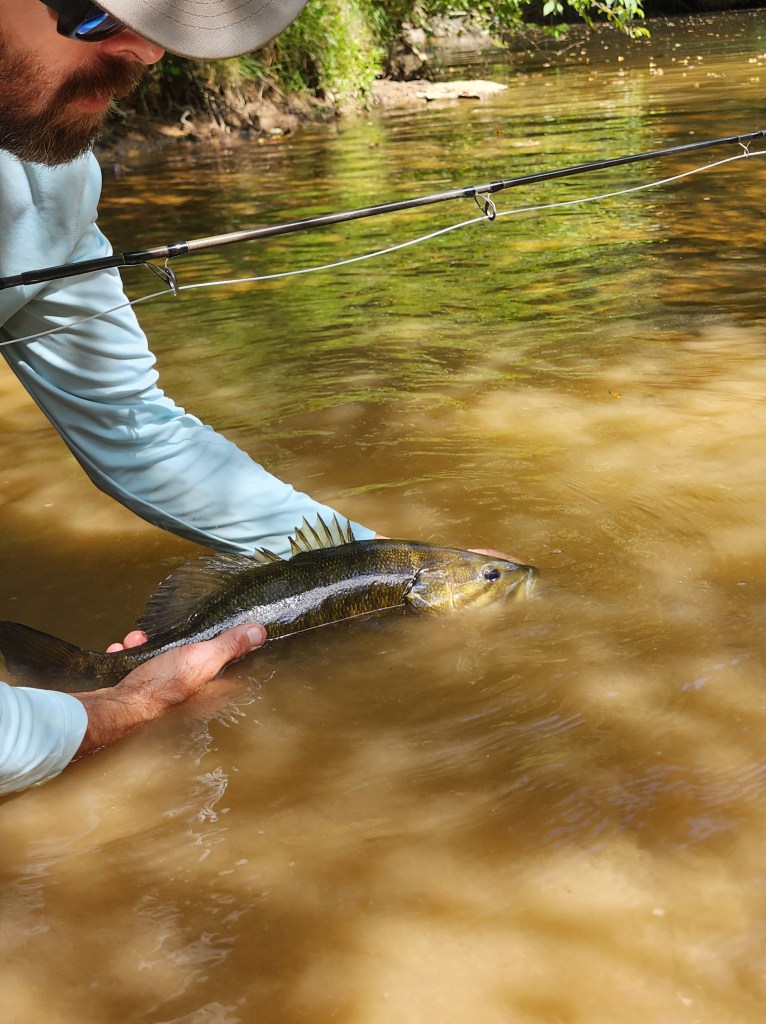
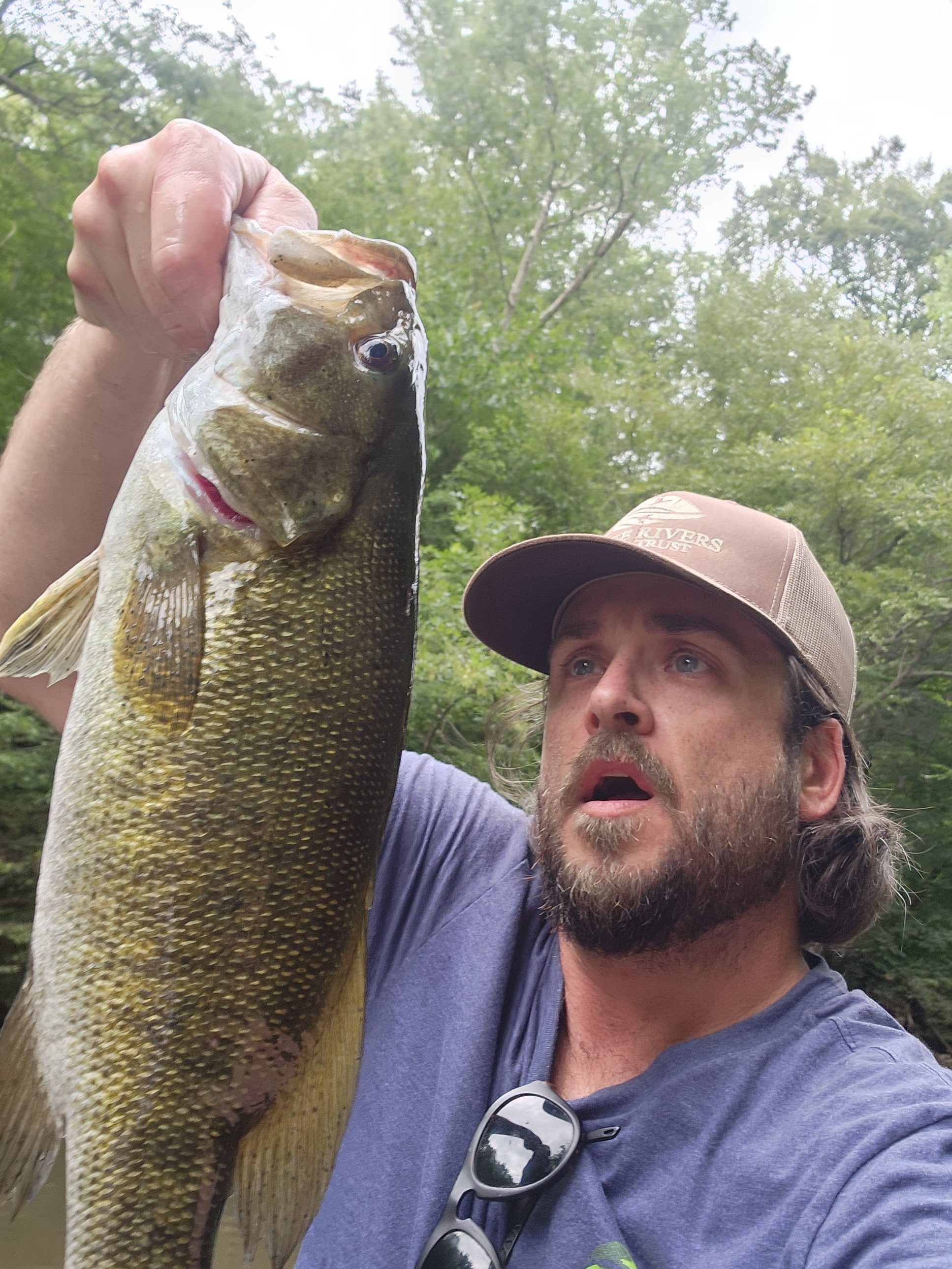
I had one fly and nothing else, so I figured I’d give it a shot until I inevitably snagged in one of the low-hanging sycamores that line the river on both sides. I stepped out into the water with it running right-to-left in front of me. One cast downstream and then a backhand cast upstream directly into the current. The black popper drifted back towards me, and I looked down to get the line off my legs. When I looked up I saw a shadow behind the fly, and the eat was so gentle that I had to take a split-second to remind myself that there definitely aren’t any trout in Montgomery County. If I hadn’t been watching I’m not sure I would’ve felt anything and likely would have missed the fish. I lifted the rod tip and the water exploded where the fly had been. Fish on. A few drag-pulling runs later, plus one sketchy moment where she made a break for a downstream log jam, and I had her in hand. Miraculously, I had crammed the tape measure in my back pocket earlier in the day because I’m not the most organized person and, true to form, had failed to put it back where it belonged after using it. The fish came up just short of 21.5 inches on the tape. She was skinny, probably due to the low-water conditions that plagued most southeastern streams this past summer, but at that length was still a lifetime fish for the state of NC. Some quick documentation of the digital kind, and she faded back into the river like a ghost. From the time I stepped in the river to the time I released the fish, I would guess 5 or 6 minutes went by. Sometimes one more cast is all it takes.
I’ve been back a few times since then, toting a few skunks back to the truck but also coming tight on a few more good fish. A friend of mine who guides for a living went on one of those trips with me, and his was the 2nd biggest smallmouth I’ve seen come out of that river. The only thing that gives me a bigger rush than catching the fish of lifetime in an unlikely place, is replicating the feat with a friend in tow. This is a guy that has rowed me into plenty of fish over the past 3 or 4 years so to say I owed him one would be an understatement. Again true to form, there was no tape present to measure his fish, but I’d guess it was somewhere between 18 and 20 inches which means the fish was somewhere between 10 and 15 years old. Mine from July was probably a little older than that. She would have hatched around the time I graduated from Clemson, and likely lived a relatively undisturbed life until she slipped up and ate the wrong bug on a hot summer day.
As the days start to get a little bit longer and wild bird seasons fade into the rear view mirror , my mind is beginning to turn back to spring flowers and summer thunderstorms. To isolated places where there’s still a little magic to be found.
 theslantedshed.com
Leave a comment